Many cultural institutions today begin their narratives with a promise: “it will be interesting,” “it will be modern,” “it will be accessible.” The Sztuka Obecna Foundation starts from a different place – from a sense of unease that many of us know all too well: the world is accelerating so rapidly that we increasingly struggle to keep up with its meaning. This is where their emphasis on the “presence” of art comes in: not as decoration for the present, but as something capable of guiding people through the chaos of change, because it carries the experience of generations.
It still sounds like a manifesto – but it’s worth treating it as a probing question: what does it actually mean for art to be “present”? Is presence about exhibition, publicity, digital visibility? Or perhaps the opposite: grassroots work, the painstaking preservation of what crumbles over time – in private archives, in drawers, in family memories, in catalogs that were never created?
Source: Unsplash
The Foundation as a workshop for meaning, not a megaphone
The charter contains a key sentence: the impetus for establishing the foundation arose from experiences of working ‘at the intersection of art and business’, and art is described as a ‘space for dialogue’ and a ‘living bridge’ between worlds. This phrase is often overused in institutional language – here, however, it is immediately ‘grounded’ by a list of activities: archiving, cataloguing, digitisation, building a digital database, exhibition and publishing activities, education, conferences, and even conservation.
This is important because it shifts the focus from a narrative of ‘promotion’ to one of responsibility. In this sense, Sztuka Obecna resembles a conservation workshop or a critical editorial team rather than ‘yet another event organiser’: in their own words, modernity is not a spectacle, but a tool (sometimes the only one) for ensuring that fragile traces are not lost.
And yet this approach has a dark side that cannot be overlooked if one is to take the subject seriously. Digitisation is often confused with preservation: a scan soothes the conscience, metadata pretends to be memory, and the ‘database’ gives the illusion of completeness. Yet the presence of art is not, after all, the sum of files. It is this tension – between the archive and life – that the foundation explicitly incorporates into its programme, speaking not only of preservation, but also of making art accessible and fostering its reception within society.
An interdisciplinary team: when biographies become a method
The most interesting thing is that interdisciplinarity doesn’t appear here as a buzzword, but as a consequence of his life story—or rather, as a way of working in which different languages come together without an interpreter.
Thus, three realms that usually operate separately converge in a single place: analytical precision (combined with managerial experience and strategic thinking, where “risk” is called by its name), technical sensitivity (painting, design, editing, and the construction of visual narratives), and an awareness of new media (sound, moving images, the internet—that is, areas where the work also lives as a record and an experience). Added to this is the practice of documentation—photography and video understood not as embellishments but as a secondary circulation of the work—as well as legal competencies that organize what is not visible in the exhibition: authorship, inheritance, ownership, and institutional responsibility.
This mosaic is significant not because it “sounds nice,” but because it allows us to both ask questions and take action: to conduct a careful investigation, organize scattered traces, give them editorial and digital form, and at the same time secure their foundation—so that the presence of art is not a fleeting flash, but a lasting reality.
Two case studies: Sawczyn and Cukier as a test of memory
For the time being, the foundation’s programme focuses on two projects, both explicitly described as ‘interdisciplinary’. This is no coincidence – rather, they represent two different ways of approaching the same problem: what should be done with a body of work that does not fit into simple institutional narratives?
Eugeniusz Sawczyn: intimacy and metaphysics on a small scale
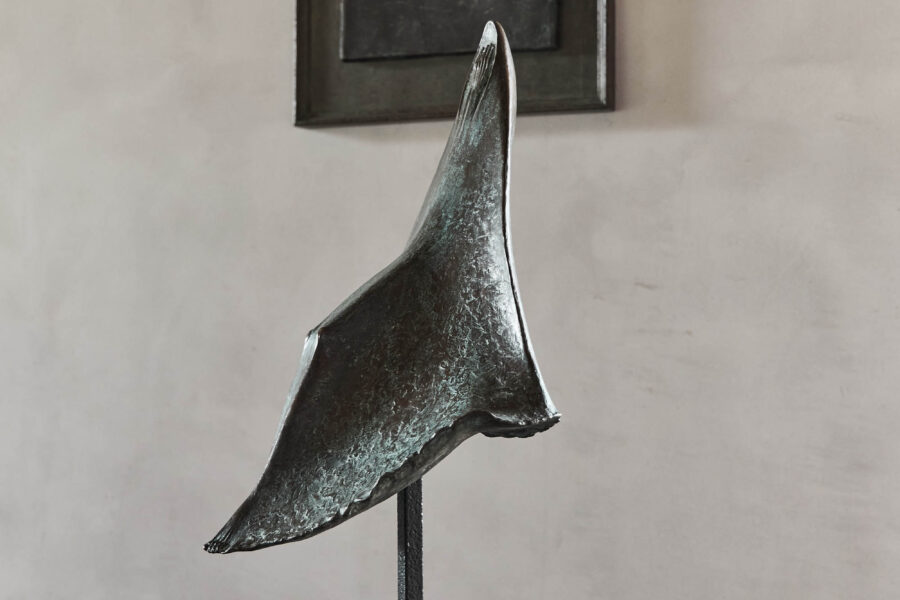
The description of the project on Sawczyn emphasises that these are small, three-dimensional sculptures arranged in series; they exude intimacy and solitude, but this solitude is intended to be ‘apparent’, as the works open up a spiritual dimension and a ‘community of souls’. The aim of the project is very specific: cataloguing, digitising and fully documenting the legacy, and introducing the works into the exhibition circuit and museum collections. In the background are the partners/patrons: the Academy of Fine Arts in Warsaw and the Centre for Polish Sculpture in Orońsko. In terms of the issue at hand, this is a story of fragility: small forms are more easily lost in time, and the ‘spiritual’ dimension of the works does not protect them from the physical decay of the archive.
Stanisław Cukier: craft, institutions, and yet — the need for order
The project on Stanisław Cukr employs a more ‘historical-institutional’ language: his biography (Zakopane, former long-standing headteacher at the Kenar School), museum collections, awards, consistency and high technical quality. And yet the outcome is similar: the organisation and digitisation of the body of work, and the documentation of the creative process (models, photographs, sketches). It is an interesting counterpoint: even when an artist is recognised and present in collections, their work ‘from the inside’ (notes, models, traces of decisions) may still remain invisible. And without this layer, art becomes merely the final product – stripped of its human warmth.
The most difficult question: can ‘presence’ be designed?
*Sztuka Obecna* speaks of art as something that draws a ‘clear, straightforward line’ of meaning in a world of growing complexity. It sounds lovely, but it is also risky: in the history of culture, a ‘clear line’ has been promised all too often, only to end in oversimplification. Perhaps, then, the fairest way to view this foundation is not as a ready-made answer, but as a practice of inquiry. In the charter, ‘promotion’ is listed alongside ‘archiving’, ‘modern technologies’ alongside ‘conservation’, and ‘events’ alongside ‘databases’. This juxtaposition suggests that presence is understood here not as a flash in the pan, but as a long-term endeavour: work whose effects cannot be fully measured by the number of page views.
What’s more, the foundation is still in its infancy – its reports page indicates that, as an organisation registered in 2025, it has not yet completed a full financial year. This is a significant moment: the institution is only just ‘gaining momentum’, yet it is already setting out a programme that will require patience and rigour.
And perhaps this is precisely where an ‘outside’ observer should pose the final question (the most existential, yet also the most practical): are we still capable of shouldering, together, things that do not offer immediate gratification? If not, art will be ‘present’ only as an image. If so – it may become what they speak of directly: a bridge that is not a metaphor, but a path.