Prof. Adam Brincken
Department of Painting
Jan Matejko Academy of Fine Arts in Kraków
RECOMMENDATION
for the project ‘Rediscovering the Work of Eugeniusz Sawczyn’
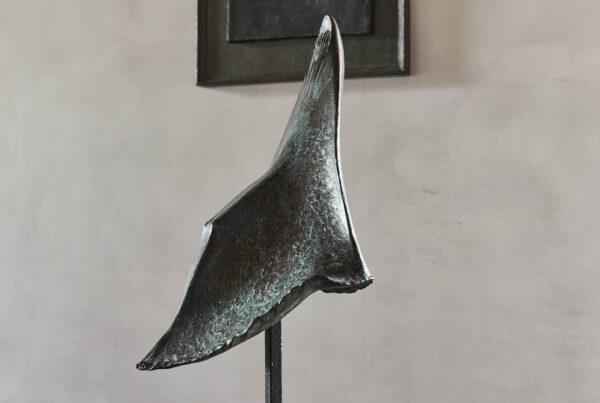
I am trying to interpret the sculptures and drawings left to us by an artist who died prematurely, yet who, with a quiet heart but in a whispered form, revealed himself to viewers here in Poland and there in Canada. How might one find the key to the delicacy of his sculptor’s touch? To the barely curved surfaces, and the fragments of humanity and nature emerging from them.
I thought he must be someone introverted, hidden away from the world, from everything and everyone. And when he draws, where does this gift of wandering across the surface of the paper come from, with a solitary ladder propped up against it? Why? To be forever on the way to the heights and ideals, to climb those same stairs again and again?
His sculptures captivate with their intimate stillness. When drama features in their themes /Dante, The Fall of Icarus, Persistence, 1987, Transience, 1985, Pride, 1983, Puppets, 1983, / this is balanced by respite and prayer / Dream, 1997, Transience, 1995, Waiting, the polyptych Enlightenment, 1986, Liberation, 1997, Enslaved, 1987, Reborn, 1987, Trinity, 1989, Ascension, 1989, Breath, 1989, Farewell, 1998
These small brown plaques, which, thanks to their frames, resemble paintings with their axial composition—linked to the Renaissance tradition—are both monumental and intimate at the same time. They move the viewer and immediately induce a state akin to reflection and contemplation. Everything that happens on their surface is delicately stirred, slightly revealed, like the corner of a duvet, a pillow or a cloud. What remains is a hand, feet, an emerging face or one hidden within the symbolic triangle of the Trinity. Only The Forest is leafless; Enslaved and Reborn are like two sides of a coin, whilst Farewell once again encloses existence within the triangle of a cloak. Everything here is imbued with an extraordinary and sublime precision of detail. Taken as a whole, they become poetry.
Eugeniusz Sawczyn was a younger colleague of mine: when I began my studies at the Academy of Fine Arts in Kraków, he was starting his studies at the art school in Jarosław. It was also my school – and that of others. It was from there that the Academy’s future deans and rectors emerged. But it came as a surprise that he chose to study at the Faculty of Sculpture at the Warsaw Academy, when studies in Kraków were dominated by the ‘Jarosław crowd’. It took me many years to understand his choice back then.
The two universities differed markedly: those who yearned for the grand scale and the buzz of the sculptors’ community chose Kraków. Those who felt the need for an intimate, poetic narrative chose Warsaw. But it was not merely the choice of artistic milieu that was decisive for the artist’s path in sculpture. I am almost certain that the conciseness and metaphorical nature of Mazu’s sculptures and reliefs, as well as the drawings and prints of Alfred Kubina and Jacek Gaj, were undoubtedly a source of support for him.
It is not easy to speak in a whisper about what hurts and what delights when, these days, just as in the theatre, all you need is a microphone stuck to your face. How can one speak ‘from the stage’ so that a natural whisper can be heard in the back row? How can one make the sculptor’s and draughtsman’s delicate words one’s own, carrying them close, drawing one in with the plane and light of the relief?
Wherever you are—in Poland, Canada, or anywhere else—now is the time to read this sculptural poetry. The world has had enough of shouting, of the clamour and din of folly. Now, or never, is the time to gaze, to listen, and to immerse oneself in the artist’s unique, tender, and irreplaceable world.
I am fully convinced that showcasing Eugeniusz Sawczyn’s body of work and promoting his art in every possible way is not merely our duty today, but a necessity… for the sake of humanity.
Adam Brincken, summer 2025