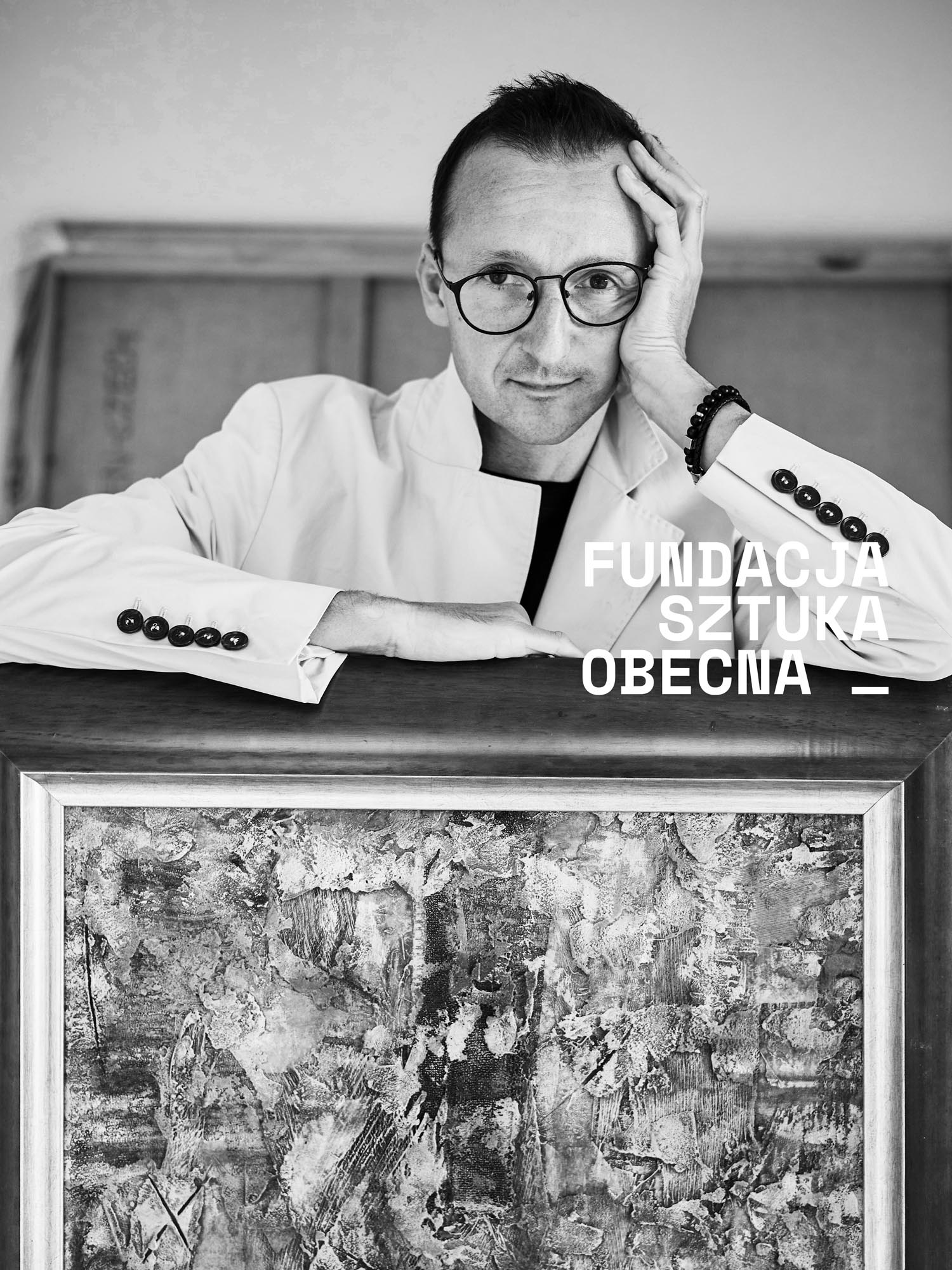
An interview by the editorial staff of the Culture and Art website with Tomasz Czech, founder of the Sztuka Obecna Foundation.
An interview on what the “presence” of art means today: between the archive and life, digitization and memory, procedure and sensitivity. The conversation touches on practices of documenting and making artistic output accessible, as well as the risks that arise when memory is reduced to mere accessibility.
Culture and Arts Editorial Team: The word “present” is central to the Foundation’s name. What does it mean in practice – beyond just being a catchy slogan?
Tomasz Czech: For me, this word is more of a commitment than a declaration. The “presence” of art isn’t merely about something being visible – online, in a catalog, or at an exhibition. Presence begins where art truly re-enters the circulation of meaning: it has context, description, continuity, and the possibility of encountering the viewer. Sometimes it’s an exhibition, and sometimes it’s invisible work: organizing an archive, discussions about rights, documenting scattered works. In those cases, presence is more of a process than an event.
That sounds like a critique of the “accessibility” era. Do you think that culture today confuses memory with accessibility?
Very often. A file offers a sense of comfort: “it’s already there,” “it’s already saved.” But a record is not yet memory, and access is not yet a conversation. You can create a great database and yet save nothing if there is no continuity: verification, metadata, context, and then meaningful sharing. That is why we are interested in the tension between the archive and life. We don’t want to pretend that digitization “solves the problem.” It merely opens up new questions.
What prompted you to establish the Foundation in the first place? Was it an artistic gesture, or rather a response to a systemic gap?
Both. On the one hand, there is sensitivity – the experience of working in the fields of art, editing, imagery, and form. On the other, there is daily practice: we see how easily artists’ bodies of work disappear when documentation is scattered and responsibility is blurred among private archives, institutions, and collectors. The foundation was established out of the conviction that the “memory of art” requires not only emotion but also procedures—standards, order, and work discipline.
The Foundation’s website mentions the idea of a “bridge” between art and business. Many organizations use similar language, often for marketing purposes. How much of that is actually true in your case?
This might sound suspicious unless we clarify: for us, “bridge” doesn’t mean a flashy sponsorship. Rather, it refers to a long-term relationship in which art isn’t just a decoration, and business isn’t merely a wallet. From the foundation’s perspective, this means, among other things, sorting out legal and ownership issues, building stable models of cooperation, and thinking about the sustainability of projects—including financial sustainability—without compromising on their purpose.
You said “procedures.” Art and procedures rarely go hand in hand. Aren’t you afraid that institutional order will kill what is alive in art?
This is a risk, which is why it must be acknowledged. But a lack of order carries an equally great risk: works without descriptions, pieces without attribution, scattered and irretrievable materials, and legal disputes that block access. The procedure doesn’t have to be a muzzle—it can be a framework that allows art to survive. It is crucial that order does not become an end in itself. It is meant to serve the purpose of allowing the work to re-enter the conversation.
In that case: what’s your approach? What steps do you take when working with an artist’s body of work?
First, diagnosis and inventory: what exists, where it is, what condition it’s in, and how to describe it. Then documentation: photography, video, and organizing accompanying materials: sketches, models, notes, and correspondence, if any. At the same time, the legal aspects: copyright, ownership of the objects, permissions, and relations with heirs and owners. And only then comes making it accessible: a database, publications, and, in the long term, collaboration with institutions capable of bringing the collection into wider circulation.
You say “we” – the interdisciplinary nature of the team really comes through in this project. What does that mean, exactly?
It can’t be done with just one skill set. There are people with strategic and organizational mindsets, there are those with artistic and editorial skills, there are new media experts, there’s photo and video documentation, and finally, there’s the crucial legal infrastructure—because without it, archiving projects can get stuck for years. There’s also pedagogical experience, because what we make available should be accessible—not just “recorded,” but told. Interdisciplinarity isn’t just a buzzword for us. It’s a prerequisite to ensure the project doesn’t fall apart at any of its critical junctures.
Two projects – Eugeniusz Sawczyn and Stanisław Cukier – seem like two different worlds. What do they have in common?
What connects them is the issue of memory and continuity. In one case, the fragility of circulation is particularly evident: dispersion, smaller forms, the risk of “disappearing” in silence. In the other, the body of work has institutional points of reference, but there remains a vast amount of material that is not “in the museum”: the process, sketches, models, contexts. In both cases, the stakes are the same: will art remain merely a trace, or will it return as a living narrative with which someone can engage?
And what do you personally find most difficult about this job?
Patience with things that don’t yield immediate results. And the ability to balance order with sensitivity. When working with an archive, it’s easy to fall into a technical routine: describe, scan, organize. Yet behind all this lies someone’s life, someone’s hand, someone’s choice of form. The hardest part is staying mindful and not reducing art to a catalog.
From the Foundation’s perspective, can art be “saved with a file”?
A file is necessary, but not sufficient. You can preserve data but lose the meaning. You can have images but lack a narrative. You can have a catalog but lack an audience. That is why we want the archive to be a beginning, not an end – a starting point from which we can move forward: toward education, exhibitions, publications, collaboration with institutions, and a real connection with the audience.
What would you say to a reader who, upon hearing the word “foundation,” thinks, “just another organization talking about itself”?
I’d like this not to be a story about us, but about practice. About how art can survive at all today: in a world of haste, oversimplification, and short attention spans. If this conversation has any meaning, it’s because it touches on a broader issue—and perhaps the experience of many people—namely, that what is valuable often doesn’t disappear all at once. It fades away little by little.
Tomasz Czech
foundation board member
– an artist, painter, and poster designer by education and passion, graduate of the Academy of Fine Arts in Krakow. For over a quarter of a century, he has been involved in graphic design and publishing art publications. He studies philosophy and theology.